Mississippi Public Broadcasting has restored service to 90.9 WMAO(FM) across the Mississippi Delta from a temporary setup following several months of downtime.
The station is licensed to Greenwood, Miss. WMAO’s 100 kW ERP broadcast site was damaged due to a severe ice storm in January, and then went offline completely following a March high wind event.
MPB tells us that as of Sept. 2, the signal that serves the Mississippi Delta is back on the air, but at a much lower power from a temporary antenna.
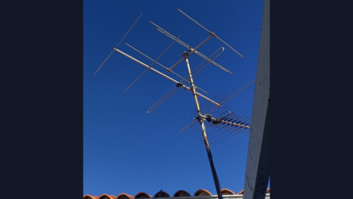
The temporary setup utilizes a custom Jampro JCPB-2H antenna mounted at 450 feet AGL, fed by 500 feet of RFS 1 5/8-inch Heliflex cable.
Using a Gates FAX-15 backup transmitter, the circularly polarized omni system generates an effective radiated power of approximately 7.5 kW combined FM+HD. Running at just under 10% of its licensed ERP, the signal gives regional coverage that overlaps with neighboring stations in Oxford, Ackerman and Jackson, MPB said.
Timeline
Following the destructive Jan. 24–25 ice storm across the south, tower engineers battled icy roads, downed trees and subfreezing temperatures that lasted several days after the storm, with no power at nearby gas stations to pump fuel for generators.
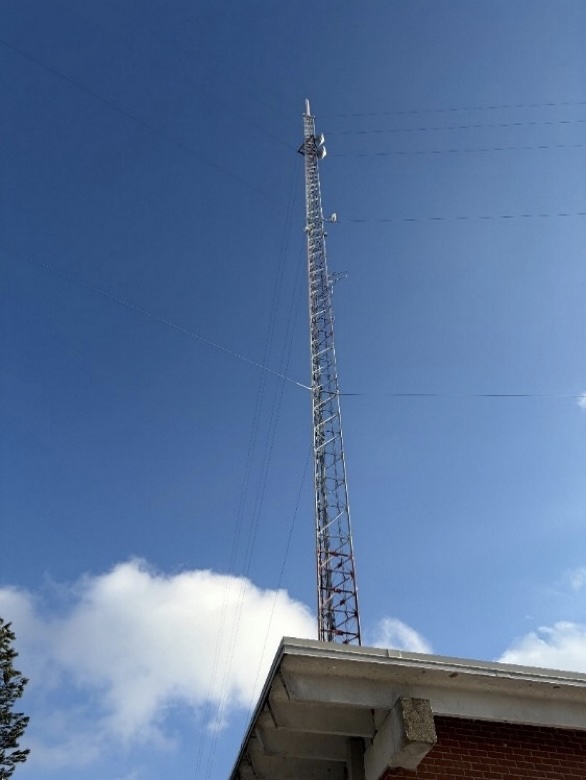
Once on-site, crews also had to dodge 2- to 3-foot chunks of ice melting and falling from hundreds of feet above on the tower, MPB said.
Powerful windstorms, meanwhile, swept through the Inverness, Miss., transmitter site just prior to a March 20 inspection. Those storms caused the feed line to the station’s antenna to fail catastrophically. MPB filed for a silent special temporary authority with the FCC for WMAO at that time.
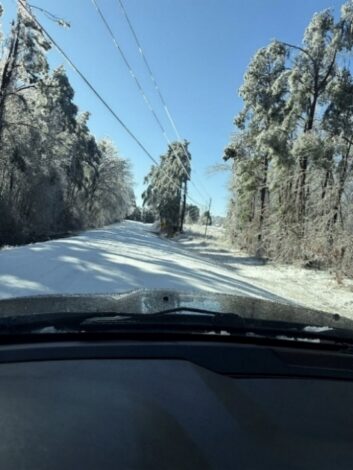
An inspection revealed severe damage in the 3 ⅛-inch solid copper coaxial transmission line that carries the output signal from the transmitter to the antenna, MPB said. The failure was isolated to WMAO’s FM radio service and did not affect its co-located MPB television signal.
MPB sent a rigging crew on-site to disassemble the line to reveal the extent of the damage. Upon separating sections of line between 300 and 600 feet above the ground, the team discovered carbon soot and evidence of extreme heating, likely caused by a mechanical failure where line sections join at a coupling component known as a “bullet.”
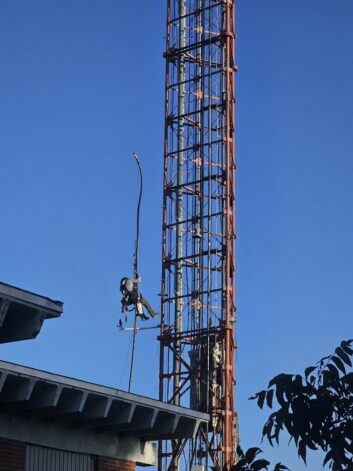
Crew members estimated that up to 300 feet of line needed to be removed from the tower, brought to the ground, cleaned, refurbished and fitted with replacement components before reinstallation.
Funding
Restoration was delayed while MPB waited on state emergency funding from the Department of Finance and Administration, which will be partially reimbursed by FEMA and MEMA. Although MPB declared a state emergency after the storm, the funding was tied to the start of the new fiscal year in July, which affected the repair timeline.
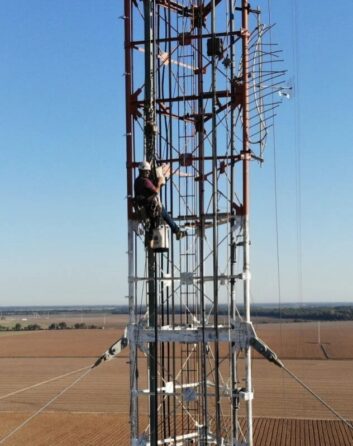
In July, MPB moved forward with the DFA to purchase and install an emergency antenna. That antenna, a Jampro model, was shipped with coax in August.
Following the arrival of the replacement equipment, MPB deployed a crew to the WMAO transmission site.
Engineers and technical staff installed the gear and completed repairs to return the station to a temporary state on the air while awaiting additional funding and parts to restore full operations.
[Do you receive the Radio World SmartBrief newsletter each weekday morning? We invite you to sign up here.]