The NAB is pointing to research that suggests 80% of AM stations in the United States could improve their signal quality by using single-frequency boosters to solve coverage challenges.
The new engineering study was commissioned by the NAB and the National Radio Systems Committee in late 2025. It conducted by the consulting engineering firm of Cavell, Mertz & Associates.
Many AM stations already have translators on the FM band, but this discussion is different.
The study sought to estimate how many AM stations might benefit from using AM boosters placed near the edge of coverage and/or in urban centers where reception is diminished due to reduced RF signal power and high levels of RF interference.
David Layer, VP of advanced engineering for NAB, told Radio World before the NAB Show that the NRSC’s ultimate goal is to develop a technical record to support adoption of a petition for rulemaking at the FCC to establishes rules for AM boosters.
According to the study, the proliferation of modern electronic devices has caused increases in AM noise floor, especially in urban areas.
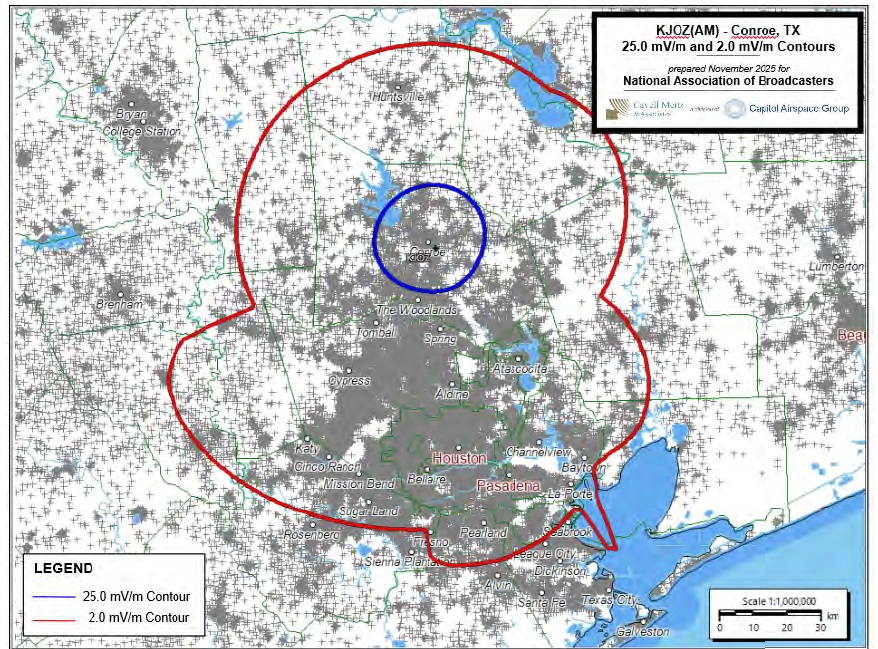
As part of the study, as an initial step, the engineering firm mapped the 25 mV/m and 2 mV/m contours for each of the 4,355 AM stations in the FCC’s AM database.
Eight rimshot AM stations were chosen for mapping. The study examined the population within a station’s core 25 mV/m contour vs. the broader 2 mV/m contour. It found that for some stations, a significant share of listeners often resides outside the strongest coverage area, which would make these stations good candidates for improved reception through strategically placed AM boosters.
The NRSC says stations with a higher concentration of listeners beyond the 25 mV/m contour may have opportunities to improve the listener experience “by strategically locating AM boosters in farther-out population centers, which theoretically suffer from high AM noise and low AM signal strength.”
Additionally, four high-power, urban stations were studied to demonstrate that there are close-in suburban areas where AM stations could have better coverage with the use of a booster.
Those stations included WSB in Atlanta, WHSQ and WINS in New York, and KNX in Los Angeles.
The report states that all the AM stations mapped are “illustrative of stations that would presumably benefit from having an on-channel AM booster.”
It concludes there are a significant number of candidates for increasing coverage using boosters. However, an AM station would need to be studied to determine whether a booster would be helpful and the cost involved, according to the report.
“Each market and situation is obviously different and would require thoughtful consideration and analysis,” the report states.
David Layer told Radio World earlier that the research will consist of a number of phases, including investigation into small antennas suitable for booster station operation and field testing.
The aim, he said, is to identify a full-service AM station to conduct booster experiments.
“We hope to identify a station in the Washington, D.C., area as that is where our testing resources are located. Once a plan is in place for conducting tests on a specific station, I expect other parts of the project will move forward,” Layer said.
You can read the study on the NRSC website.
The committee serves as an industry-wide standards-setting body for technical aspects of terrestrial over-the-air radio broadcasting systems in the United States. It is sponsored jointly by the Consumer Technology Association and the National Association of Broadcasters.