Nick’s Signal Spot is a new feature in which Nick Langan explores RF signals, propagation, new equipment and related endeavors.
Where I live in New Jersey, there are just so many FM signals around.
As a result, for the best long-distance signal monitoring results, I’ve learned over the years that sometimes, height isn’t always might. My FM Yagi antennas at approximately 10 feet above the ground will hear weak signals that my time-trusted APS-13 Yagi, mounted to my roof at about 20 feet above the ground, will not.
I attribute it to higher noise floor levels up above the ground.
But outside the eastern megalopolis? Well, that’s a different story. I’ve always wondered the kinds of things you could hear with a receiver connected to an antenna on a high tower!
Another fellow FM long-distance enthusiast, Jeff Lehmann (A1JL), shared with me a video engineer Roman Porterfield took earlier in February from North Dakota.
Porterfield is the single full-time engineer for i3G Media in Jamestown, N.D.
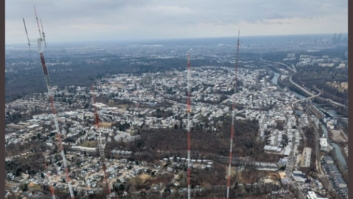
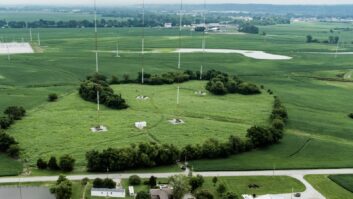
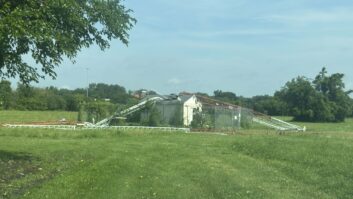
The tower site in the video, located in Eckelson, N.D., had lost power. Taking advantage of the silence, he plugged his Airspy HF+ software-defined radio into the site’s auxiliary antenna — which was pointed east from the site toward Valley City — and he started tuning around.
It is a fascinating look at what can be heard from about 640 feet above the ground.
At about the 12-minute mark, Porterfield switches reception to the main antenna, pointed westward toward Jamestown. Toward the end of the video, there is a fascinating look at the range of stations he is able to hear on 104.5 FM, a clear channel in that region.
First, 104.5 KCCR from Blunt, S.D., serving Pierre, comes in steady at about 205 miles. Then, it is replaced by 104.5 KBUN from Blackduck, Minn., arriving from the opposite direction at a distance of 171 miles.
The modern receiver
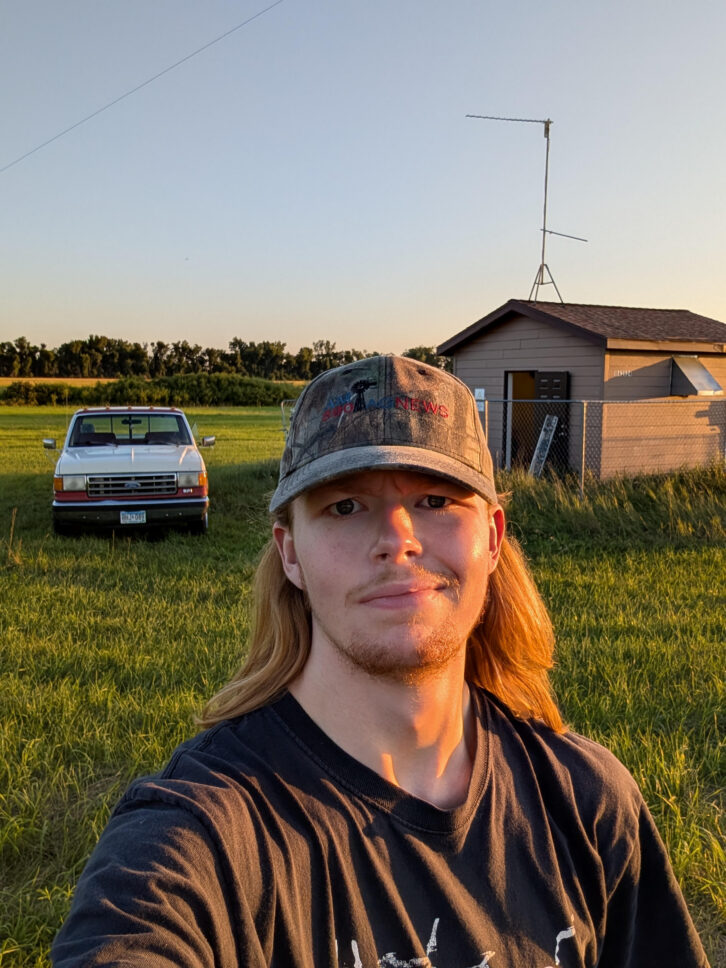
Porterfield, 22, told me he always had an interest in radio, but “The Modern Rogue” YouTube channel featured an episode on SDRs and he became even more intrigued. He bought his first SDR while he was still in high school, about 25 minutes outside of Minneapolis.
Now in North Dakota, Porterfield uses SDR IQ file recordings to archive sections of the FM band, particularly during road trips.
“Think radio tapes but instead of audio, it’s the full IQ of the recording,” he said.
I’ve always had trouble myself with managing SDR IQ file storage. IQ files are .WAV files, and recording several hours can encompass terabytes of data.
But Porterfield also writes software, and he pushed out to his GitHub repository a tool that allows you to chop IQ files into smaller, labeled segments and output them as FLAC-compressed files. It’s something I want to try out very soon.
In a database, Porterfield said he has nearly 23,000 clips, dating back to June 2020, many of which are of stations that no longer exist.
Porterfield told me he’s also working on metadata middleware software for RDS, stream data and HD Radio. He hopes that it will be a free, open-source, modular RDS middleware that treats metadata like a flow graph with logic inputs from Axia for aspects like simulcasting and advanced routing.
SDRs, I believe, are the future, and might be the link to engaging smart young folks like Porterfield again in the medium!
Ski and scan
Unless you can seek out high towers to plug into, most of us just need to travel to find those open dial locations.
Radio World contributor and long-distance signal enthusiast Karl Zuk nominated two sites — Yosemite Valley, Calif., and Lake Louise, Alberta — for our “Quiet FM Dial” locations list, noting they are phenomenal places to listen for meteor scatter.
Regarding the Canadian location, Zuk writes:
“Lake Louise now has two CBC transmitters nearby. When I first went up there in the 1980s, the only thing on FM was an aural TV transmitter on 87.75. At Lake Louise, just pick any frequency and sit for a while.
“Guaranteed to hear meteor scatter,” Zuk said.
“You really should go there. Phenomenal skiing and Rocky Mountain majesties.”
Is your transmitter alright?
Meanwhile, the discussion on long-distance signals, including the story I wrote on summer and fall tropospheric enhancement sparked a memory from longtime reader Bob Gonsett in southern California.
He recalls a moment circa 1980 when he received a call from a frustrated general manager of a well-known Mt. Wilson FM station in Los Angeles. The GM was upset that an adjacent-channel station in San Diego was causing temporary interference to his signal.
Gonsett shared the details of that memorable conversation:
“[The GM] assured me that the interference affected not only his station but other Wilson signals as well. He went on to explain his rationalization of the situation: There were certain summer days and times when all of the San Diego FM stations secretly agreed to greatly increase their transmitter output powers.
“My explanation of temperature inversion layer ducting — as we called it at the time — seemed to fall on deaf ears, unfortunately,” Gonsett explained.
[Read the Signal Spot from Nick Langan for More DX-Related Stories]