Kirk A. Harnack, CBRE, CBNE, is a strategic consultant to MaxxKonnect. This is one in a series about optimizing your air chain. Read more in your latest free ebook.
Cleaner radio starts with eliminating analog noise.

For decades, broadcast engineers have pursued “better-sounding radio” through improved microphones, cleaner consoles and better processing. But in today’s radio plant, one of the biggest opportunities for air chain improvement is surprisingly simple: Remove as much analog circuitry from the signal path as possible, especially older analog equipment that adds measurable noise and alters characteristics such as group delay and impulse response.
Modern air chain optimization is less about adding devices and more about removing the ones that quietly degrade performance every day.
That means retiring aging analog distribution amplifiers. It means replacing legacy analog STL systems. And increasingly, it means transporting the FM multiplex signal itself over IP using linear IP-audio methods or modern MPX-over-IP technologies.
In the author’s experience, these improvements are not merely measurable; they are audible. Station staff — and often listeners — have commented on the cleaner and more open sound after such changes were implemented.
The hidden problem with “good enough”
Many FM stations still operate with signal paths that evolved over decades. A station may have started with analog consoles, analog STLs and analog processing, then gradually added digital equipment over time. The result is often a hybrid plant with multiple conversion stages and legacy analog infrastructure still embedded in critical parts of the chain.
The problem is that many analog stages contribute component noise, crossover distortion, level uncertainty, group delay and degraded impulse response.
In many cases, older analog distribution amplifiers are among the worst offenders. These devices were often designed in the 1980s or 1990s and may only achieve noise performance 80 to 90 dB below peak program level. That may have been acceptable decades ago, but in a modern FM air chain, it becomes increasingly obvious once the rest of the system is cleaned up.
Engineers are often surprised when bypassing an aging analog DA results in improved stereo clarity, cleaner high-frequency detail and lower background noise.
Noise and distortion introduced anywhere before the exciter become transmitted artifacts — imperfections that are faithfully delivered to the listener.
This issue becomes especially important when discussing legacy analog STL systems, particularly traditional composite STL radios operating in the 950 MHz band. These systems were extraordinarily reliable for many years and still remain in service across the country. But they also introduce inherent FM noise into the multiplex baseband.
Typically, the noise floor of an analog composite STL may only be 70 to 75 dB below modulation peaks. Again, that was acceptable in another era. But today, with modern audio processing and cleaner source material, that residual noise becomes increasingly noticeable.
And unlike noise buried deep inside a studio monitoring chain, STL noise is directly transmitted by the FM exciter. That means stereo subcarrier noise, pilot contamination and upper-baseband artifacts all become part of the listener experience — especially in fringe coverage areas where stereo performance is already challenged.
IP transport is no longer experimental
Reliable IP connectivity is now available through fiber, licensed microwave Ethernet, public internet, managed circuits, 5G wireless gateways and even LEO satellite-based services such as Starlink.
The important lesson, however, is not merely to “use IP,” but to engineer IP transport with redundancy and path diversity. Modern STL design therefore increasingly centers around path diversity and intelligent failover.
MaxxKonnect works with broadcasters across North America to address this critical aspect of modern air chain design. As broadcasters increasingly move STL systems toward IP-based architectures, the reliability of the transport path itself becomes just as important as the audio quality it delivers.
MaxxKonnect’s prioritized wireless and satellite services can provide an IP path for primary connectivity or back-up redundancy to a terrestrial internet service. Because a wireless path is independent of the primary connection, it can provide true path diversity for critical on-air STL systems, helping maintain program continuity during outages and reducing the risk of a single point of failure.
Composite-over-IP can be a smart option
One of the most important developments in modern FM transmission has been the rise of composite or MPX transport over IP.
Rather than transmitting left/right audio to the transmitter site and recreating the multiplex signal there, composite-over-IP systems transport the fully generated MPX baseband directly to the exciter. This offers several advantages.
First, it preserves the exact output of the audio processor, including stereo generation, clipping behavior, RDS injection and other composite-domain characteristics. The air sound becomes more predictable and repeatable.
Second, it eliminates analog STL noise entirely.
Third, it enables much more sophisticated filtering and spectrum management of the multiplex signal itself.
One of the most widely recognized technologies in this area is MicroMPX. What makes this particularly interesting is that it does not rely on traditional psychoacoustic bitrate reduction methods. Instead, it uses highly efficient mathematical reduction techniques specifically optimized for the FM multiplex spectrum.
That’s a key distinction.
Rather than treating the signal as conventional audio, the system intelligently manages portions of the MPX spectrum that are intended to remain quiet anyway.
For example:
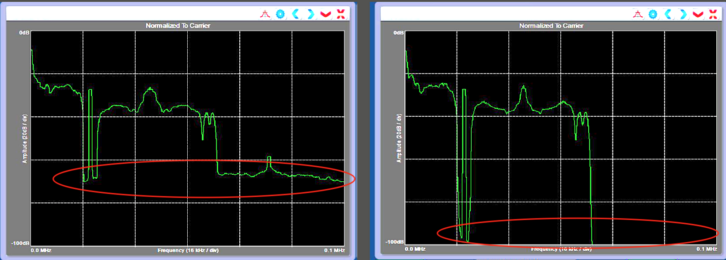
- The area around the 19 kHz stereo pilot is carefully protected.
- The 57 kHz RBDS/RDS region is effectively filtered and stabilized.
- Upper baseband regions are cleaned up to provide additional spectral room for services such as HD Radio injection or future multiplex components.
The result is an exceptionally clean composite signal that can be transported at surprisingly low data rates while preserving outstanding on-air performance (Fig. 1).
MaxxKonnect has helped refine MicroMPX implementation approaches and broaden adoption within the broadcast industry, particularly in the United States. Beyond simply making the technology available, a collaboration with MicroMPX developer Thimeo has focused on practical deployment considerations, real-world integration and helping broadcasters understand how MPX-over-IP techniques can be incorporated into existing facilities.
As a result, technologies that once may have seemed experimental to many engineers have become increasingly accessible and familiar within day-to-day broadcast operations.
Today, approximately 20 models of MicroMPX encoders and decoders are available from roughly a dozen manufacturers. In addition, nine FM audio processors offer MicroMPX encoding capabilities, while six FM transmitter platforms include MicroMPX decoding either as an option or as part of their standard feature set.
This level of integration suggests that composite-over-IP transport has moved well beyond the experimental stage and into mainstream broadcast infrastructure.
The case for linear audio over IP
Another approach worth considering is transporting uncompressed linear audio all the way to the transmitter site using audio over IP infrastructure.
When bandwidth and connectivity allow, this can provide an extraordinarily clean signal path because there is no perceptual coding, no psychoacoustic compression and no codec artifacts being introduced into the program chain. Instead, the audio arrives bit-for-bit identical to what left the studio.
Linear IP STL systems will transport digital audio perfectly with the same 1s and 0s that go into such an STL being delivered to the far end. Twenty-four-bit, 48 kHz-sampled linear audio typically requires about 2.5 Mbps to transport.
While this form of audio delivery is essentially bit-perfect, it generally depends on an IP transport path with extremely low packet loss and properly engineered buffering and redundancy.

Whether using AES67, Livewire, WheatNet-IP, Dante or another compatible transport technology, the principle remains the same: Preserve the digital signal without alteration until it reaches the transmitter facility.
This approach still generally requires audio processing and stereo generation to occur at the transmitter site, which has traditionally been an acceptable design philosophy and remains common in many facilities today.
For stations moving away from analog STL systems, linear AoIP transport can represent a major step toward a remarkably clean and transparent air chain.
Improved stereo coverage is real
One of the more interesting field observations from broadcasters adopting modern MPX-over-IP systems is improved stereo coverage.
At first glance, this seems counterintuitive. After all, transmitter power and antenna systems remain unchanged.
But the explanation becomes clear when examining the multiplex baseband itself.
A cleaner MPX spectrum reduces incidental noise and unwanted modulation products surrounding the stereo subcarrier. That means receivers operating near the stereo threshold can maintain stereo lock more effectively and with fewer audible artifacts.
Engineers describe the improvement as “quieter stereo,” “more stable imaging” or “less swishing” in fringe areas.
In practical terms, listeners may simply perceive that the station sounds stronger and cleaner than before, particularly near the fringe areas of stereo coverage.
And because FM remains fundamentally an analog RF medium, improvements in transmitted baseband cleanliness still matter enormously.
A new philosophy
For many years, air chain optimization meant adding another box. Today, the philosophy is often the opposite.
The best sounding stations are increasingly the ones with fewer analog stages, fewer unnecessary conversions and fewer opportunities for accumulated noise.
AoIP infrastructure, AES67 transport, AES/EBU interconnection and MPX-over-IP STL systems are allowing engineers to simplify the signal path while simultaneously improving reliability and sonic performance.
Most importantly, these improvements are audible.
Listeners may never know why a station sounds cleaner, more open or more stable in stereo. But they notice the difference.
Sometimes the most meaningful air chain improvement does not come from adding another device; it comes from identifying and removing what has been quietly degrading the signal all along.
Don’t be afraid to try new techniques to achieve the best possible sound quality. Whether simple IP codec transport, MicroMPX or linear digital audio, the technology is there and engineers can implement these standards without a big learning curve. After all, radio has an overlooked advantage to the streaming services it now competes with: the ability to run uncompressed audio from playout to receiver.
MaxxKonnect is an ebook sponsor. Learn about its products at https://maxxkonnect.com.