The AM Improvement Working Group of the National Radio Systems Committee has been working on characterizing AM radio performance and on solutions to improve AM radio reception.
The NRSC is cosponsored by the National Association of Broadcasters and the Consumer Technology Association. It is a group of scientists and broadcast engineers pooling their talents to find solutions to broadcast transmission problems.
An NRSC guideline describes technology that can aid AM stations with their coverage and improve listener experience.
The problem
You have heard it many times: a beat note between co-channel AM stations in fringe reception areas. Stations on the same frequency as the one you’re listening to can create an annoying low-frequency hum or beat in received audio. It is distracting and can cause listeners to tune away.
According to FCC rules, the AM transmitter carrier frequency tolerance is +/– 20 Hz. That means two transmitters could be as much as 40 Hz apart and still be legal.
An audio beat of that kind between two stations can be quite annoying. The most common example happens when listeners are driving out of a station’s protected contour and are continuing to listen to a popular program. Interference from another station, on the same frequency, causes listener fatigue and tuneout.
A worse case is when stations are about 1 Hz apart. Listeners hear a station’s audio rise and fall every second. It is common when a station is pounding in via skywave during critical hours. That is often when advertisers are paying to get impressions to listeners during drive time. Ouch!
The solution
For years, a handful of AM stations with on-channel AM boosters have successfully synchronized their transmitter frequencies to minimize interference to listeners.
That same idea can be applied to co-channel AM stations everywhere. It has been shown that a 3 dB or more improvement in listener audio signal-to-noise ratio (SNR) can be achieved with carrier synchronization. That is the equivalent of doubling transmitter power!
Think of this as extended coverage. The greatest benefit is to co-channel stations that know they are interfering with each other but have had no option to remedy the problem until now.
Technology
Hardware is readily available to discipline the carrier frequency of an AM station to its exact licensed frequency. GPS satellites can be used as frequency references to do the work. A typical cost of $1,000 for hardware with installation can get almost any AM station synched up, so to speak.
Most AM transmitters today have 10 MHz reference oscillators, which are divided down to the station’s operating frequency. The transmitter then amplifies it up to licensed power. That 10 MHz oscillator can be replaced by an external source, usually via a jumper change within the transmitter. Some older transmitters might want an external RF input to be on the carrier frequency, but that is doable too.
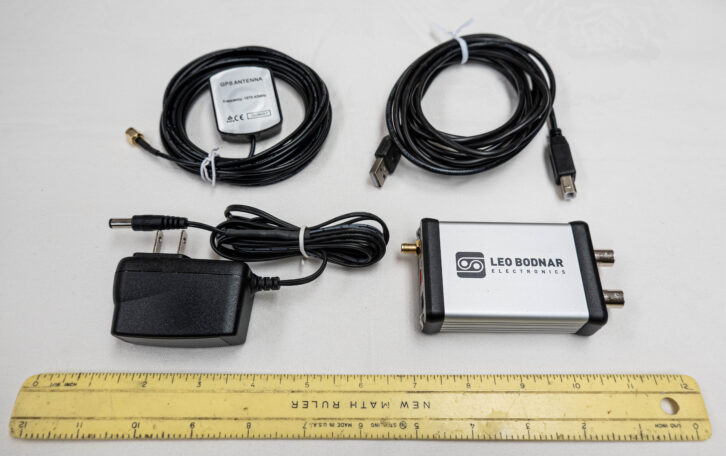
Almost any GPS synchronized time base could work. The unit I tested, shown in Fig. 1, was a Leo Bodnar Precision GPS Reference Clock. It comes with a small GPS antenna and 16-foot cable for $233.95. They also have GPS antennas for outdoor use, which have 33- and 98-foot cables. This might be required in many situations.
This particular unit can be programmed to generate any frequency between 450 Hz and 800 MHz. It will continue working if GPS signals are lost due to antenna problems or whatever. The RF output will be very close to correct and will move back to the exact frequency when the GPS input it restored.
Listening
In listener tests between two synchronized stations, it is amazing to hear how reception cleans up. Audio from the weaker station may be heard in the background, but the annoying beat note between carriers is gone.
Note that this is voluntary. All stations should be synchronized to get the greatest benefit on the frequency to be synchronized. All stations on all frequencies could and should synchronize.
Regarding local Class C channels, this will likely benefit the daytime. But with dozens of stations heard at night, there will be more audio than carrier. Therefore, there is no guarantee that this technology will work for every station in every situation.
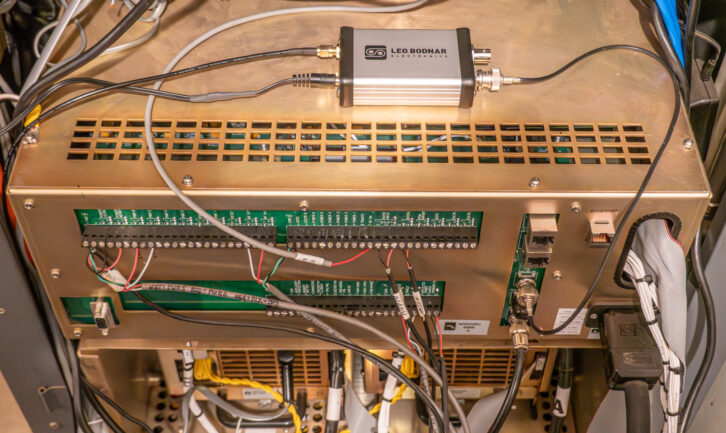
Fig. 2 shows a typical installation on a Nautel J1000, a 1 kW AM transmitter. A Leo Bodnar Precision GPS Reference Clock is fed into a BNC jack on the back of the transmitter, replacing the transmitter’s RF oscillator. A small GPS receive antenna mounts outside the transmitter building.
There is no harm in AM broadcasters synchronizing their carriers. No FCC paperwork is required, although it would be best to confirm all is well during an annual NRSC occupied bandwidth and RF harmonic test.
(Read the full text of the G102 document.)
Comment on this or any article. Write to [email protected].