“Twenty-six miles across the sea, Santa Catalina is
a-waiting for me …”
 |
|
The
view down to Avalon Harbor and the city of Avalon, Catalina Island’s population
center.
|
The Four Preps didn’t quite get
the mileage right — it’s only about 20 miles from the nearest point on the
southern California mainland to the ferry dock at Avalon on Catalina Island —
but their 1958 hit record was right on the money when it pinpointed “the island
of romance.”
However, the romance of Catalina
dissipates quite a bit when you’re trying to keep an AM directional array
running at an island location that’s not only a long ferry ride from mainland United
States but which is remote even by Catalina standards.
That’s the challenge the
operators of what’s now KBRT(AM) have faced for six decades, and it’s the
challenge the station’s current owner, Crawford Broadcasting, is giving up as
it moves KBRT to a new site in the hills of eastern Orange County.
That site is an engineering marvel in its own right,
as you’ll be reading about shortly in the pages of RW, but the island site
deserves a full accounting of its own as it heads into the sunset of radio
history.
“Water
around it everywhere, tropical trees and the salty air …”
KBRT’s Catalina story begins with John H. Poole, one
of southern California’s most colorful broadcast owners.
Poole built his own ham radio
station at age 14, shipped out as a Merchant Marine radioman before World War
II, then spent the war serving in the Army Signal Corps. Afterward, he bought
stations in Santa Maria (KSMA) and Pasadena (KALI) before turning his attention
to Catalina in the late ‘40s.
 |
|
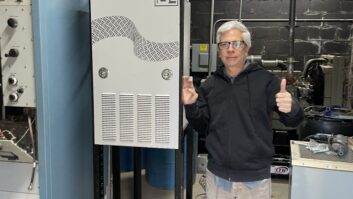
KBRT
chief engineer Bill Agresta stands in front of the station’s island transmitter
site.
|
While conventional wisdom said
there was no room for another new signal on the already-crowded Los
Angeles-area AM dial, Poole quickly figured out that by locating offshore, he
could blast out a 10,000-watt daytime signal at 740 on the dial that would
carry over the Pacific salt water to blanket the coast from Santa Barbara to
San Diego.
When Poole signed KBIG on the
air in 1952, it wasn’t the first offshore broadcaster in the region. Major
Jordan L. Mott had run 250-watt KFWO (“Katalina For Wonderful Outings”) from
his home in the island town of Avalon from 1925–1928, using the station to
promote tourism to a mainland audience.
A few years later, a
Panama-registered ship hosted its own high-powered unlicensed station, “RXKR,”
targeting coastal listeners in southern California. Poole, too, took advantage
of his exotic offshore location to build an audience.
Operating from studios in downtown Avalon, a few
blocks from the ferry docks (with additional mainland studios and sales offices
in Hollywood), Poole’s KBIG billed itself as “The Island Station,” and he
boasted to Broadcasting magazine
in 1953 that his new station was operating in the black within four months of
sign-on.
By then, Poole was off to a new
challenge. He’d already dabbled in UHF television with an experimental
transmitter on Signal Hill in Long Beach. In 1953, Poole was granted a
commercial construction permit on Mount Wilson for what would become KBIC on
Channel 22 — and while KBIC never broadcast more than a test pattern, the “John
Poole Building” on the mountain became home by 1959 to a new KBIG-FM, with a
massive signal on 104.3 that reached all of southern California not only by day
but also after sunset, when the KBIG(AM) daytime signal yielded to 740’s
clear-channel occupant, KCBS from San Francisco.
By the 1960s, KBIG-FM’s
fulltime signal had outpaced its AM sister in the ratings. The downtown Avalon
studio was closed, and whatever limited Catalina-produced programming on the AM
station remained was originating from a small studio at the three-tower
transmitter site up in the hills.
Poole exited the broadcasting
business in 1969, starting yet another new career as a winemaker. (After his
death in 2003, Poole’s son took over operations of the Mount Palomar Winery,
which continues in operation.)
Bonneville took over the KBIG
radio stations, and 740 began a slow transition to a mix of music and religious
programming. In 1980, Bonneville sold the AM (by then renamed KBRT) to Crawford Broadcasting. Crawford moved “K-Bright” to new mainland studios in
Costa Mesa, Orange County.
Under Crawford, KBRT’s
programming went entirely to religion, still using that big signal from
Catalina to reach listeners up and down the coast. The breakdown of the clear
channels in the 1990s landed KBRT a limited night authorization, but with a
measly 113 watts, KBRT after dark couldn’t overcome the big KCBS signal
anywhere on the mainland, and so it continued to operate daytime only.
 |
| Transmitter room at ‘KBRT Ranch’ in its final
months. Processing and STL racks are at far left. In the bay, at left is the
Nautel AMPFET backup transmitter, at center is the Kintronics phasor and at
right is the Nautel XL12 main transmitter that will become a backup at the new
mainland site. |
KBRT’s next big brush with the
headlines was an unfortunate one: In the spring of 2007, a contractor working
on replacing the station’s guy wires was using a circular saw to cut up the
scrap metal from the project. Sparks from the saw ignited the dry brush around
the site, touching off what would turn out to be a 4,200-acre blaze that
scorched much of the central part of the island, destroying power and electric
lines and stopping just short of the edge of Avalon itself.
The towers and transmitter building remained standing,
and KBRT was back on the air within days on generator power, first playing CDs
from the on-site studio and then establishing a satellite link to the mainland.
The fire’s aftermath brought lawsuits that weren’t settled until just last
year, and helped to push Crawford to seek out a more accessible site off the
island.
“Forty
kilometers in a leaky old boat, Any old thing that’ll stay afloat …”
If you set out, as we did, to
visit KBRT’s island home, you most likely begin your trip on the water. Unless
you’re chartering a plane or helicopter, the route to Catalina starts on the
mainland at either Long Beach/San Pedro, just south of Los Angeles, or Dana
Point in Orange County. After a little more than an hour on the ferry, you
arrive in Avalon, the island’s main town.
For most visitors, Avalon itself
is the main tourism destination: There’s a quaint shopping district on the
water just a few blocks from the ferry landing, an assortment of
bed-and-breakfasts and small inns, and if you’re adventurous, you can rent a
golf cart for the day and drive up into the hills to look down on the pretty
little town tucked into a cove.
A golf cart can even take you
up to the low hill overlooking the ferry dock that’s home to the antenna for
the island’s community radio station, 100-watt KISL (88.7). But if you’re
hoping to go see KBRT’s transmitter site, you’ll need something heftier than a
golf cart, because carts can’t go beyond the gate that blocks access to Airport
Road as it heads up into the hills going north from the city.
The gate, and most of the rest
of the island, belongs to the Catalina Island Conservancy, established 40 years
ago by the two families that had owned most of the island’s land for more than
half a century. (One of those families was the Wrigley family, heirs to the
chewing gum and baseball fortune; the Wrigleys’ Chicago Cubs held spring
training on Catalina from the 1920s until the 1950s.)
 |
|
Detail
of a mosaic map of the island outside the ‘Airport in the Sky,’ a few miles
north of KBRT. For over half a century, the ‘Island Station’ has been a
prominent Catalina landmark.
|
Private vehicles are a rarity
on Catalina, with a waiting list for the island’s 3,600 residents that can last
years. Most of those vehicles aren’t allowed into the wild part of the island
north of the gate, and so the half-hour drive up to the “KBRT Ranch” finds us
passing only a handful of other trucks on the paved, but bumpy, road that
ascends into the hills over some tight switchbacks.
“A
tropical heaven out in the ocean, covered with trees and girls …”
The Four Preps’ search for “romance,
romance, romance, romance” would not have ended very happily up at the KBRT
site, where both trees and girls are in notably short supply. But for those of
us enamored of the romance of AM radio, it’s here in abundance.
The “Ranch”
sits nestled in a clearing up among the hills, some 1,500 feet above sea level
along the winding road that runs from Avalon north to Catalina’s famed “Airport
in the Sky.”
From the airport road, a short driveway leads past the
gate to the low-slung building that serves as KBRT’s transmitter facility,
backup studio and for many years now as the home of the station’s resident
engineer, Bill Agresta.
Our visit in early December is
actually something of a homecoming for Agresta; for several months now, he’s
been spending all his time on the mainland (“America,” as the islanders call
it) working with Crawford’s corporate engineering team, led by Cris Alexander,
on the construction of the new KBRT.
The impending
move explains why the transmitter room isn’t quite as pristine as Agresta kept
it when he was living here. It’s full of gear that will be shipped off the
island in the months to come, once the new site in Orange County is up and
running.
In the meantime, we get a brief
opportunity to see what’s involved in keeping an offshore transmitter site
running. Like most Crawford properties, the transmitter of choice here — as at
the new site — is Nautel: There’s an XL12 running as the main transmitter and
an AMPFET as the backup.
There’s already floor space blocked off at the new
transmitter site for the XL12 to be shipped over to become a backup itself to
the new NX50 already in place there; the AMPFET will be sold, probably to start
a new life in some other country.
The rest of the plant is simple
but very functional. To the side of the transmitter room, there’s a small
studio, filled with dusty cassettes and reels of the “Island Talk” public
affairs show that once met the community service requirements out here.
Behind the
transmitters, a workshop contains every part imaginable, a necessity when the
nearest Radio Shack is half an hour away in Avalon and anything more extensive
must be procured from the mainland.
There’s a small apartment out
here where engineers resided for more than half a century, and next to that a
set of covered bays where KBRT stores its lawn mower and its generator, also a
necessity when shore power can be an iffy proposition. (While there’s been talk
of a power cable from the mainland to Catalina, Southern California Edison
generates all the island’s power from a diesel generator plant on the coast
just outside Avalon, right next to the terminal where barges bring in all the
island’s commercial needs.)
Back in KBRT’s early days,
there was even a backup antenna here, a longwire stretched between two poles on
the hill that rises behind the building. The antenna is still there, but the
ATU is gone, though Agresta points out the passthrough where the RF came out of
the building.
Two satellite dishes just
outside the building are relatively recent additions, put in place quickly
after the 2007 fire to provide a more reliable signal path from KBRT’s Orange
County studios after the flames destroyed the AT&T line that ran up the
hills from Avalon.
Five years later, the effects
of the fire are hard to see. Hard work by Agresta and his family kept the
flames away from the transmitter building, where the roof was kept wet and
foliage carefully trimmed back. (Agresta was injured during the fire when an
overly-eager worker at the site commandeered a tractor and accidentally hit
him, breaking three ribs.)
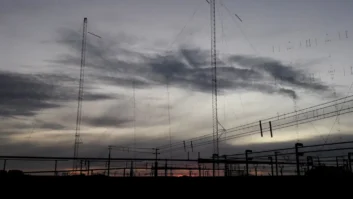
The three towers out back
survived as well, though Agresta says it was touch-and-go at points when the
fire neared the guy wires.
Sometime in February, according
to the latest schedule, KBRT will have moved from these three 285-foot towers
to its new home more than 50 miles away “in America.”
With the move complete, things
will begin to wind down. Agresta and a hired crew will return to the island to
finish packing up whatever’s left in the building that’s worth keeping, and it
will all make its way down the hill and on to a barge bound for the mainland.
The land up here at the Ranch will go back to the conservancy, which will also
figure out what to do with the towers.
When it’s all gone, now we — and
you, at least virtually — can at least say we saw “The Island Station,” and
experienced a little bit of the “romance, romance, romance” of Catalina Island’s
radio days.
The text above has been tweaked to correct the timing of the change of call sign to KBRT. Scott Fybush, a longtime RW
contributor, is the editor of NorthEast Radio Watch (www.fybush.com) and a
broadcast journalist based in Rochester, N.Y.All lyrics are from the song “26 Miles (Santa
Catalina)” written by Bruce Belland and Glen Larson.
|