I am filling in for John Bisset, who is on hiatus.

Ryan Warrey, engineer for “Delilah,” read the August column about how Crawford Broadcasting uses Raspberry Pi computers to create custom studio annunciator tools.
“You might get a kick out of knowing that Raspberry Pis practically run the Delilah show,” he told us.
“One of them has been transporting just about every word she’s said on air from her home studios, for a little over four years now.”
The show uses a VoxPro but, Ryan said, “It’s not supposed to be possible to run it remotely, because the software still uses video-game-style UDP broadcast packets, and that Layer 2 stuff can’t traverse over a normal VPN.
“But with a Raspberry Pi 4, a specific version of open-source software and some very careful firewall rules, you can build a Layer 2 bridge that can make VoxPro work like it’s on the network at headquarters.”
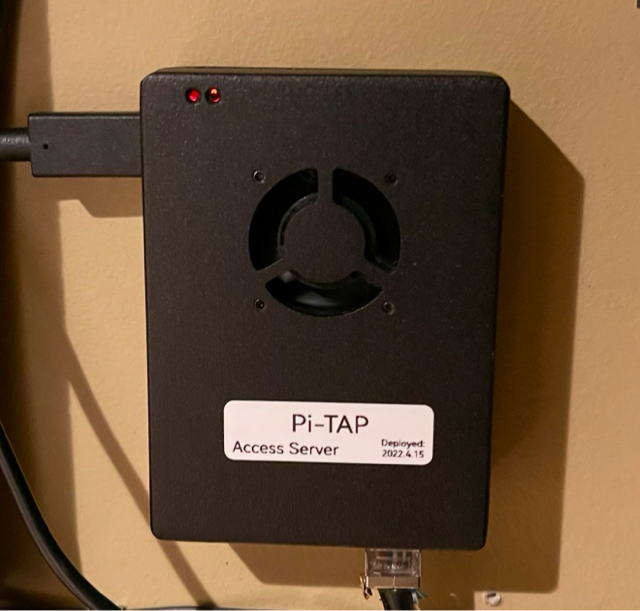
It passes connection for remote VSets too, and it only costs you a Pi plus some time configuring free software.
“The setup process involves specific versions of software, a secret command to enable TAP and some important firewall rules to make this safe to use,” he continued.
“A Layer 2 tunnel is akin to leaving an Ethernet cable to your network hanging in a dark alley way if not secured well.”
Ryan also described how the show gets its caller audio to and from the studio and monitors its shows remotely when needed.
“We’ve tried just about every option when it comes to connecting audio to remote studios. But of all things, the open-source software SonoBus is what won — lossless audio, under 30 ms, connects from anywhere, any device. And it’s free. We love the open-source world.”
Ryan is working on a project that will make Delilah’s broadcast calls entirely web-based, without relying on hardware.
“Calls are already all-digital now, so all of this could really just be done locally in a web browser and maybe a hardware controller.”
Share your favorite Raspberry Pi problem-solver with us. For now you can email [email protected].
Smart lighting
Channel Master has a professional-grade “smart” outdoor flood light that uses an F-connector, the type you see on TV cables.
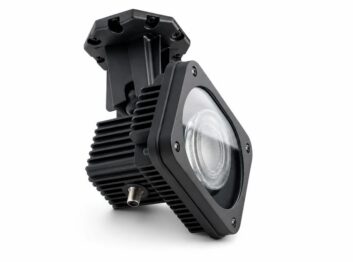
Dan Slentz spotted this and thought Workbench readers might have ideas about how to use it. “Maybe a nice thing for a station where employees can turn on extra lights outside at quitting time, or at the transmitter site.”
It uses a low-voltage power delivery system called Coax-Power for installation up to 150 feet from an electrical outlet.
Why is it “smart”? Because you can control and automate the floodlight with the Apple Home app and Siri on supported Apple devices (unfortunately not Android).
The company calls it “the only smart floodlight powered over coax cable.” It delivers up to 2,000 lumens of “clean, natural 4000K outdoor lighting” and retails for $199. Find it here.
Hip clip tip
Paul Sagi appreciated that little probe holder gizmo that we mentioned in July.
“The clip arrived today and I used it immediately,” he wrote from Malaysia.
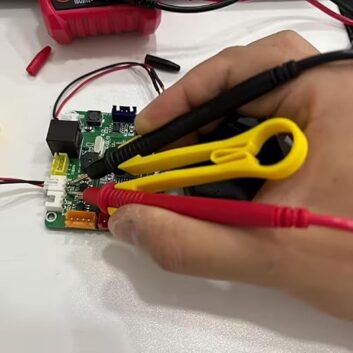
“It’s very useful, especially when you want to measure the voltage of lithium ‘coin’ batteries such as CR2032.”
The tweezer clip permits your probes to snap in place, so you can hold onto the probes with one hand and use the other to make measurements.
The holder costs only around a dollar. At the Temu or Amazon websites, search “One-Hand Multimeter Clip.”
Short-handed
“Even big groups have problems with having enough engineering staff nowadays,” according to Tom Taggart of Seven Ranges Radio in Parkersburg, W.Va.
It can get to the point where the engineering staff can’t keep track of the stations.
“My remaining FM is on a high ridge outside Parkersburg. Also on the tower is another Class A full-power FM, a translator for my AM station, three other AM translators and a low-power TV on Channel 8. Just 350 feet west is the tower for two FMs owned by one of the big national radio corporations.”
Tom relates that he was visiting his site while the TV engineers were connecting up their equipment.
“A fellow comes in the transmitter room, stares at the array of racks with the six FM transmitters, and asks, ‘What station is this?’”
Apparently the regional engineer for the big national radio company was on vacation, so this fellow was sent in from another market to fix one of their stations. He saw all the activity at Tom’s 60-by-40-foot building and assumed that was his site.