Michael Baldauf, Colorado’s “Technoguy” and fellow Radio World contributor, poses what seems like a simple question: What’s the best way to change a floodlight bulb?
Many transmitter sites use these big bulbs, typically mounted deep in their fixtures as shown in the accompanying photo. But their threads can jam, or the bulb bases and sockets can corrode over time, especially outdoors, making removal difficult.

Credit: Getty Images/Keith Getter
Then you have to grab a ladder, shatter the bulb and twist the pieces out with needle-nose pliers (after turning off the power, of course).
Michael has tried using a suction cup attached to the end of a pole, with some success. He’s had better luck by taking a wad of duct tape or similar, jamming it against the face of the bulb and screwing the bulb out.
Michael asks Workbench readers, “Are there better ideas?”
One suggestion is to get in the habit, when first installing your bulbs, of applying a layer of Vaseline or similar brand petroleum jelly around the threads of the bulb. Make sure it’s a very thin layer. Heat from the light can cause excessive amounts to drip and cause a fire hazard.
Shake, rattle and roll!
There’s an odd noise or rattle in your studio. How do you find the source?
Paul Sagi says that he would play a classical guitar CD whenever someone in a studio complained of hearing something rattle. It might be a loose loudspeaker binding post, keys on a console, whatever. Classical guitar played at moderate volume shakes things up, helping you find the source of the noise.
Archiving your thoughts
Phil Schoenthal writes to say that he enjoys the experiences and advice offered by readers in our Workbench column.
He shares some of his own broadcast experiences on Archive.org. The electronics DIY site is neat and kind of takes over where earlier DIY sources like Panaxis Productions and Ramsey left off.
There are a lot of neat ideas, though unfortunately most of the FM transmitter kits can’t be used in the United States except into a dummy load. Phil says it’s too bad that they do not seem to offer AM transmitter kits. In this country, AM kits would make more sense, with Part 15 possibilities, for both radiating and AM carrier current.
[Related: “Connecting Currents on Campus”]
Speaking of which, Phil points out that for carrier current coupling, a linear power supply, with a full isolation step-down transformer, is essential for reducing RF feedback. And yes, that GREEN GND wire may indeed have to be dealt with, and isolated, as well.
Frank’s $30 network tester
Frequent tips contributor Frank Hertel sent along a link to a $30 network cable tester that rivals the more expensive models.

Credit: Getty Images/banksphotos
You get a lot of features for $30 and can test all kinds of cable connectors including RJ-45, RJ-11, USB and BNC. It will even test installed wiring or patch cables.
The instrument can also test from two remote points, using a remote tester that is nested in, and removable from, the main unit. An LED indicates faults, while a beep provides audible annunciation of the various test results. There’s even a low-battery indicator.
Many of us now work in or with IT, so this should be a useful addition to the toolbox.
Generators keep their cool
Dave Porter, G4OYX, enjoyed our column of tips about generator maintenance from Buc Fitch.
Dave points out that in the U.K., the term “generator” is used for DC (direct current) output, while “alternator” is used for AC (alternating current) outputs.
In that column Buc recommended checking genset fluids, but Dave points out that we didn’t mention the coolant. Good point. Checking coolant level is up there with monitoring oil and fuel levels, but can be overlooked. Dave reminds us also to check the antifreeze if you live in a part of the country where temperatures get anywhere near that point.
Even in warm climates, did you know that antifreeze raises the boiling point of your radiator coolant? It also has additives that guard against corrosion and rust; and the formulation lubricates the water pump and engine seals. So it’s not just for cold weather locations. Oh, and Dave points out one other feature of antifreeze. Namely, it has the most amazing property of finding every leak in the system!
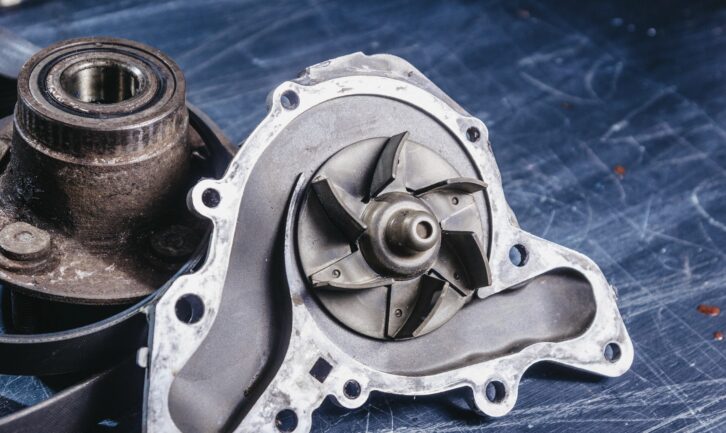
Ever wonder what the inside of the water pump looks like? See the accompanying photo.
Credit: Getty Images/mikalai sayevich
Dave is a former senior transmitter engineer with the VOA and BBC. His son Matt, G8XYJ, is now a transmitter engineer at the famous Woofferton transmitting site in England. He makes a brief appearance during a tour of the 250 kW facility that you can watch here.
Workbench submissions are encouraged and qualify for SBE recertification credit. Email [email protected].