The author is attending the CES show in pursuit of future tech that will enhance our radio industry. (Read his previous post.)
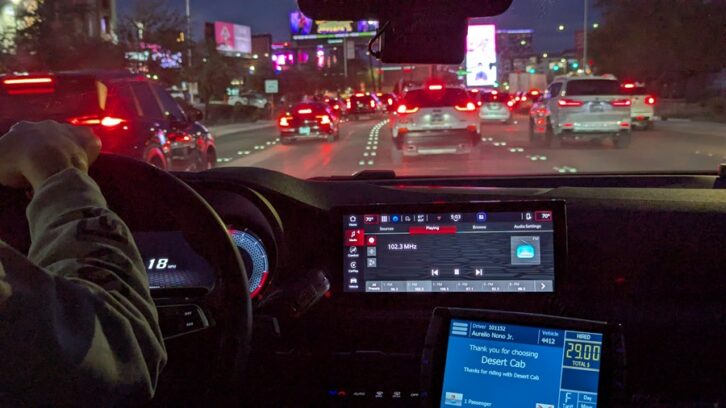
The first hour of CES 2026 upon my arrival in Las Vegas unfolded in an encouraging way. The cab driver who ferried me from the airport to my hotel was listening to over-the-air radio!
Even better, the taxi radio was tuned to FM translator K272EE, rebroadcasting AM station KQLL, known in Las Vegas as KOOL102, thus immediately validating the AM-enhancing wisdom of the recent petition for rulemaking filed by Press Communications LLC and 19 others seeking a reinstitution of the previous FM translator move window for AM stations.
The next morning, on my trip from the hotel to the West Hall of the Las Vegas Convention Center via the underground Vegas Loop, the Tesla driver had Joan Jett’s “I Love Rock ’n’ Roll” playing. I asked him the source of the music. His response was Sirius/XM Channel 25 (Classic Rewind), noting how it even reaches into the tunnels Well, I thought, at least the content he is enjoying is still linear radio as we know it.
In the West Hall, the ubiquity of AI was overwhelming. The hall this year features the CES 2026 hub for vehicle tech and advanced mobility. Finding something other than AI was going to be a challenge.
I had been forewarned about the AI omnipresence in Fred Jacob’s newsletter post, which he humurously headlined “Observations From CES 2026: Day .5”. Steve Newberry, CEO of radio dashboard visual enhancer Quu, began the first seconds of Fred’s audio blog by warning that the days of preset and habitual listening to radio “are going to shrink, shrink, shrink” because, Steve said, AI will be able to “access audio anywhere.”
On the prowl
On the exhibit hall floor are numerous automobiles, almost none being promoted by their manufacturers but instead being shown for the discrete AI technology integrated into the vehicle by the exhibiting entity.
I had the urge to get into each car and ask “where’s the radio,” but I restrained myself, deciding that being an irritant was not the way I wanted to start my day nor theirs.
Still, determined to find some new tech that had applicability to radio in cars as we know it, I began by prowling the perimeter of the floor to try to find peripheral products that would point in the right direction to radio’s continuing presence in the automobile dashboard.
As automobile dashboards morphed in the past 10 years to universally include screens capable of showing video from a back-up camera, we have seen the knobs, controls and sliders previously associated with radio gain and tuning, as well as other significant vehicle functions, become visual icons in ever larger and larger dashboard screens.
It is my theory that the National Highway Traffic Safety Administration mandate of a rear-view system for every vehicle as a child safety measure kick-started the rapid automobile dashboard transition to the arguably driver-distracting chaos of visual image controls that must be viewed to be operated.
Cars are doing away with mechanical controls easily found by touch, replaced by visual icons on a screen and tiny buttons on a steering wheel. From a driver perspective, this is an enormous safety deficiency and an unintended consequence of trying to protect children playing behind a parked vehicle.
Getting a feel
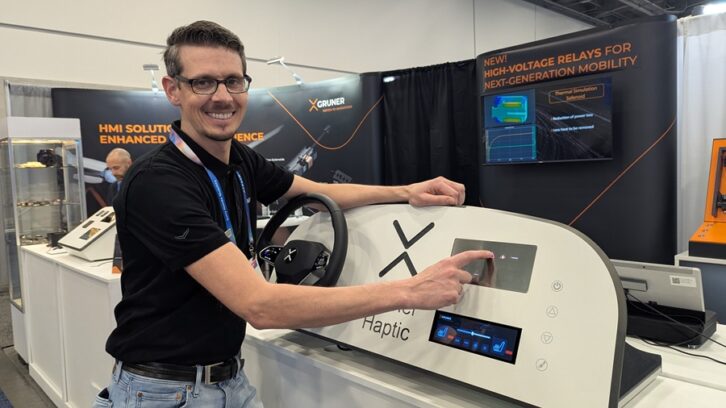
On this subject of the elimination of mechanical controls including radio knobs, I came across the exhibit booth of Gruner, attracted to it solely by the presence of the word “haptic” with reference to the sensory feel of buttons on a steering wheel and a mock dashboard.
Gruner’s haptic technology for the automobile dash and steering wheel is halfway there: The user can feel the utilization of the buttons, but all buttons “feel” the same. To get all the way there, the Gruner haptic buttons each need to each have a different feel prior to being pressed, so that the driver can control automobile functions including radio without taking their eyes off the road.
But the haptic feel of Gruner’s dash icons is at least a start in improving the distracting visual-only screen controls now prevalent in today’s vehicles.
Next, I came across a massive booth where P3 is promoting SPARQ as their own turnkey infotainment solution based on Android Automative OS. I lost my reticence and popped the question: “Where’s the radio?”
Daniel Glaenzer and Paul Stanescu from the SPARQ team assured me that radio as an over-the-air device is included in their infotainment solution. Paul said his wife listens to the radio, and more broadly, their research shows that 81% of people are still using radio.
Paul noted that SPARQ OS / Android Automotive OS serves as the vehicle’s central infotainment system, independent of the driver’s smartphone, with support for unlimited aftermarket apps.
The wrong battle?
In the almost-pure radio vein, Xperi has a significant presence in the West Hall. I stopped by the booth and noted that there is no longer that familiar wall of automobile radios displayed at previous shows.
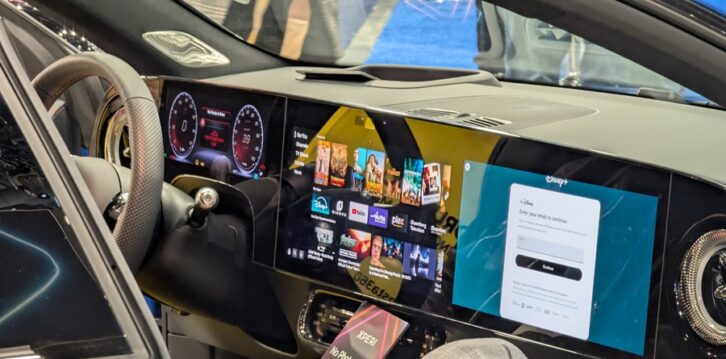
Xperi shows off three automobiles, the Genesis GV80 luxury SUV, the BMW X3 M50 xDrive and the Mercedes-Benz CLA luxury sedan. Strangely, in the Mercedes CLA, there are no video screens in back for passenger viewing, something I would have expected given that the inclusion of DTS Autostage Video is an announced part of this vehicle.
I will be meeting with Joe D’Angelo of Xperi on Tuesday to learn about their latest tech including DTS Autostage Video.
I then met up with Steve Newberry. He is CEO of Quu as well as the founder of a radio group and a former joint board chair and executive VP at the NAB. He has been vocal for years about the issues surrounding radio’s visibility and role in cars.
Our conversation started badly when I used the word “demeaning” with reference to Steve’s comment that radio listening is going to “shrink, shrink, shrink.”
“We fought so hard to protect the old model [of radio] that we are missing the opportunities for the future,” he told me. Steve warns that “radio is fighting the wrong battle” and asks, “What have we won in the past 10 years?”
He continued: “The entitlement that [radio] worked hard to earn is now irrelevant in the dashboard. AI is going to change the way that consumers interface with their technology, not just in the car and their home and their work and their social life. Everything. Radio is going to have to earn its way.”
Steve forecasts that AI will enable his Quu products to make radio stations more relatable and engaging. But he states that radio is losing the vehicle dashboard.
Quu researches and publishes studies each year that survey the 100 best-selling vehicles. The most concerning negative trend is a deep drop in “one-touch” access to even get to the radio.
Two years ago in 2024, 36% of the surveyed vehicles had one-touch access to the radio. In 2025, only 26% feature a dedicated, one-touch radio button.
I asked him what he would do if he ruled the world. Steve would encourage broadcasters to “really earn the legacy that they have … and build it for the future with meaningful programming content that is an indispensable part of their communities, for 10 years from now, not just for now.”
And Steve touches on a third rail for much of the radio industry, seeking a potential business relationship between our radio industry and vehicle manufacturers. He says such a synergy that would make sense for both.
On Tuesday, in addition to revisiting Xperi, I will learn more about Xperi and its plans, and how it has weaved AI into their product lineup. I hope to visit the North Hall for robots and the Internet of Things, the Central Hall for audio tech and the South Hall for tech accessories.
Through the century since the Roaring ’20s, radio has survived an onslaught of new tech. Some say linear programming of media is dead. I disagree. While the internet appeared for a while to emphasize “pull” content (i.e. what-you-want-when-you-want-it), that favoring of choice over linear “push” content (with radio and TV the prime examples) is largely being erased by AI.
AI for media content promises not “what-you-want-when-you-want-it.” It offers “what-you-did-not-know-you-want-anytime-you-want-it.” Reduced to its essence, for audio this sounds a lot like targeted radio programming.
The AI evolution may not be easy for jukebox stations annoying their audiences with multiple 18-unit commercial blocks. But stations that have always excelled in community service and delivery of quality audio products may significantly benefit from an AI that delivers new listeners, and advertisers, who did not know that they wanted it.