This is the third in a series about the annual Techsurvey. Read the second part on digital consumption and the first on why listeners are still tuning in.
More than four in five respondents in the latest Techsurvey own vehicles with dashboards displaying artist and title information.
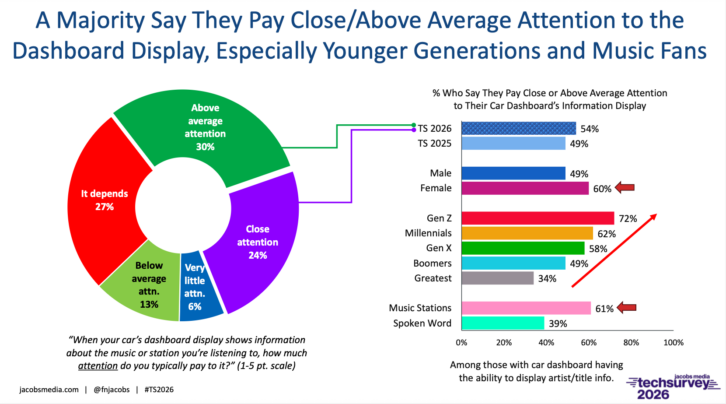
A majority of those said they pay attention to the dashboard display.
The survey from Jacobs Media found that’s especially true for younger respondents and mores with women than men.
Techsurvey results also showed that radio listeners expect more than just music to be displayed, said Fred Jacobs, president of Jacobs Media, in a recent presentation of the results of the 2026 survey.
“Metadata in the dashboard is another way that vehicles are becoming visualized. Now there are a number of car manufacturers … putting 8k screens like BMW. But the ability to be able to actually message on the dashboard is really important for radio,” Jacobs said.
The most recent survey keyed in on the messaging wants of the respondents. Emergency weather information, breaking news and traffic alerts rate especially high, according to the survey earlier this year of nearly U.S. 31,000 radio listeners.
Furthermore, Jacobs said, respondents welcomed being able to just glance down and see if there is severe weather coming, or if the stock market just lost 800 points.
“There is a pecking order for what people desire to see in the dash, but current song title and artist remains a strong top choice,” he explained.
Easy on the eyes
Jacobs emphasized the notion of visual radio in his presentation, with a central question: “Would you like video with that?”
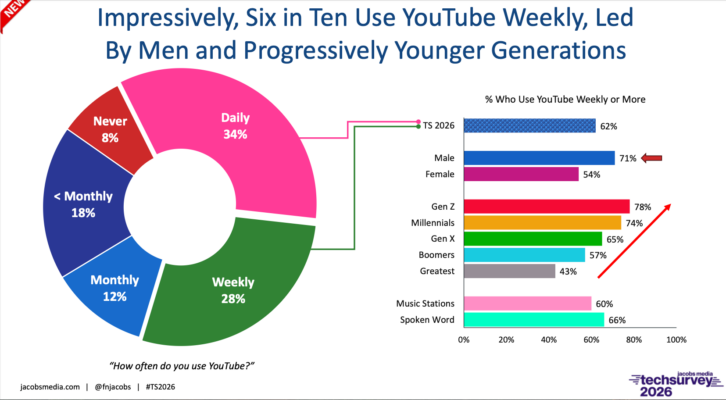
Techsurvey 2026 reinforced the importance of YouTube as part of a station’s video footprint. It remains a dominant platform, with 62% of respondents saying they use YouTube weekly. A majority of those surveyed are aware of their favorite station’s YouTube channel and visit it regularly.
“I think it’s important for those of you who either have YouTube channels or thinking about doing those to think about what the use cases are. Why does your audience go to YouTube anyway? And is there a way that maybe you can match up your content with some of the stuff that they’re already watching? You may actually be able to do that,” he said.
As Jacobs said on the TS2026 presentation: “The eyes have it.”
Radio needs to become more visually focused, he said, and short videos are part of that strategy.
“We asked how often do you actually watch short videos in the course of a normal week. Well, 71% do so on a weekly basis, which is pretty high,” Jacobs said.
Broadcasters also need to lean into video podcasts, he said.
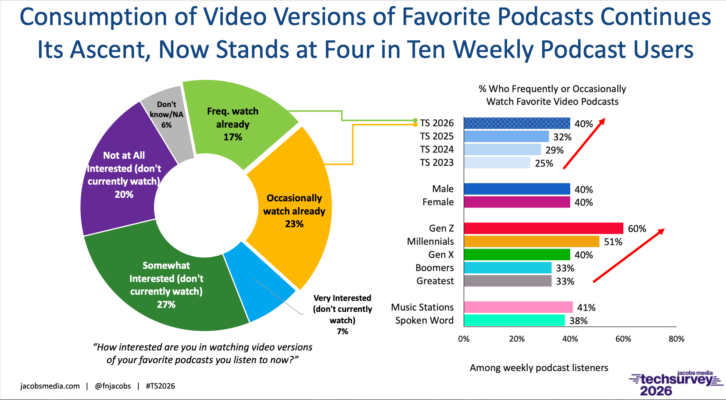
“Right now, all of a sudden, many, many podcasts are doing a video version. 17% said they frequently watch their favorite podcasts. One in four do so occasionally. We’ve asked this (question) now the last four years. This is a trend, a pretty unmistakable trend,” he said.
Men and women are a pretty evenly split when asked if they frequently or occasionally watch their favorite video podcasts.
One for the road
We’ll conclude our review of Techsurvey with a little nugget from Jacobs that is evidence of just how infotainment systems and the resulting competition in the dashboard are impacting radio listening. Jacobs points to one slide in particular to make this point.
It is the inverse relationship between driving cars with projection systems like Apple CarPlay or other built-in dashboards, and listening to terrestrial AM/FM radio in the car. In essence, as in-car media system ownership grows, AM/FM radio usage shrinks and it has year over year since 2018.

The findings point to how important metadata and visuals are in the car for radio broadcasters, Jacobs emphasized.
“Obviously, in-car infotainment systems are just growing by leaps and bounds, and this is ultimately a threat to us in radio,” he explained.
“Because the reality, of course, here is that the more options people have in the car, the more they’re going to use them. So we have got to make sure that we are really providing a service in the car,” he concluded.